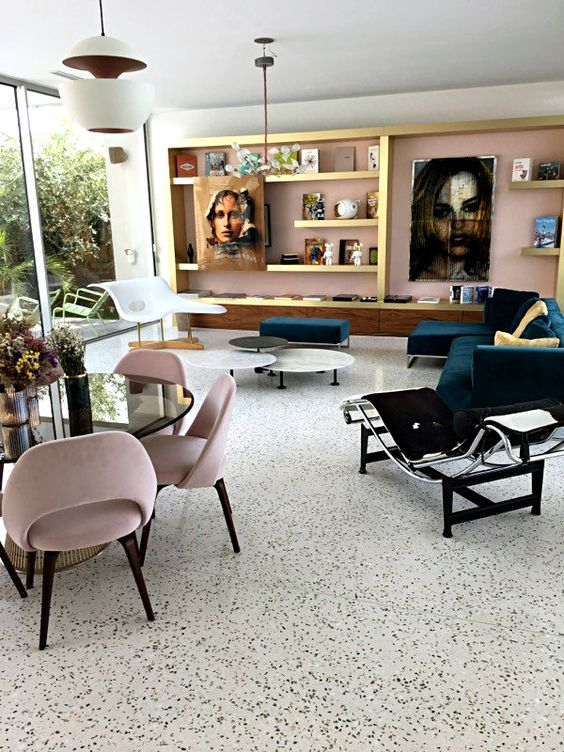
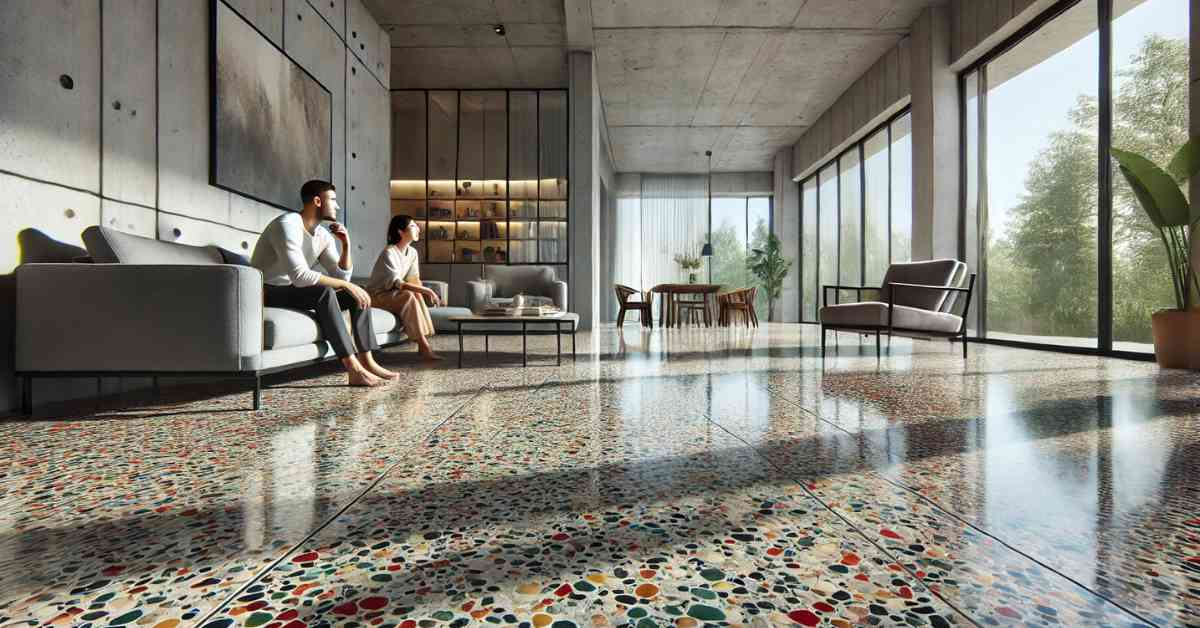
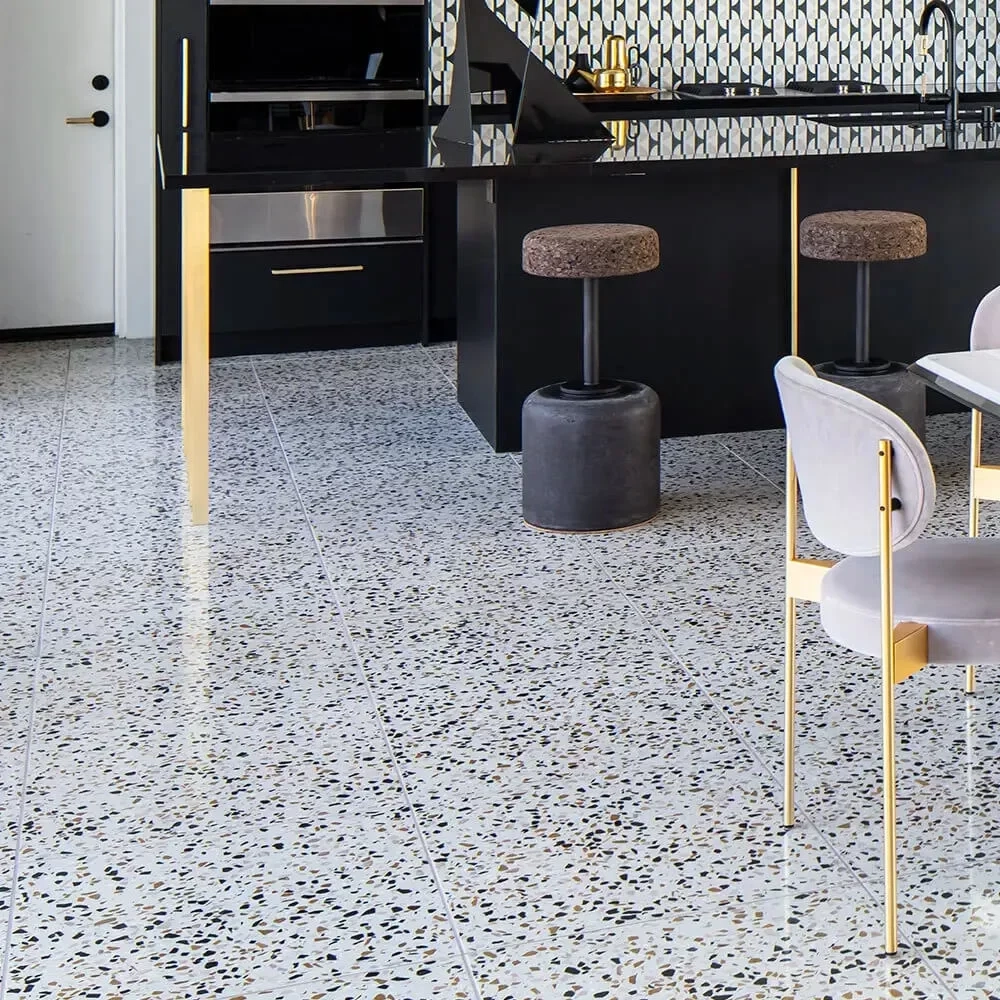
The rhythmic scritch-scritch of a heavy carborundum stone grinding across a cured slab of cement and marble dust is a sound centuries old. In 15th-century Venetian loggias, laborers known as terrazzieri would smooth down uneven floors by hand, kneeling for hours with weighted smoothing stones and goat’s milk to seal the surface. They were working class men making do with offcuts, sweeping up discarded marble scraps from elite construction sites and embedding them into clay or mortar. What began as a makeshift, budget-friendly flooring method for terrace patios eventually evolved into an architectural statement of understated luxury, winding its way through the palazzos of the Renaissance, the art deco lobbies of Miami, and the sterile hallways of mid-century office parks.
Fast-forward to today, and that gritty, adaptive spirit is undergoing a radical renaissance. Walk into any avant-garde design studio or high-end residential build, and you will notice that the material has shed its reputation as cheap, speckled institutional tile. Contemporary artisans are stripping away the rigid, prefabricated uniformity of industrial terrazzo tiles. They are returning to the fluid, monolithic pours of the past while supercharging the medium with material science, massive graphic aggregates, and a zero-waste ethos. This is no mere aesthetic nostalgia; it is a fundamental reimagining of what a composite surface can be when traditional craftsmanship collides with modern creativity.
To understand this transformation, we have to look past the smooth, glossy finish of a completed floor and examine the messy, highly technical reality of the workshop. Modern terrazzo makers are part chemist, part sculptor, and part historian. They are rewriting the rules of aggregate distribution, testing new binder matrices, and pushing the boundaries of what manual labor can achieve in an era dominated by automation. The resulting floors, walls, and bespoke furnishings stand as a vibrant rebuttal to mass production, proving that human touch remains the ultimate luxury in contemporary architecture.
The Evolution from Venetian Scraps to High-Performance Architectural Composites
The core identity of terrazzo has always been rooted in resourcefulness, but the mechanics of the craft have shifted dramatically over the centuries. Traditional terrazzo relied entirely on a lime or cement binder mixed with local marble chips, graded by eye and tamped down manually. Because cement is naturally porous and prone to cracking as buildings settle, these old floors required meticulous maintenance and occasional waxing to retain their depth and sheen. The process was painfully slow, heavily dependent on regional material availability, and limited in its color palette by the natural tones of local stone.
In the mid-20th century, the introduction of epoxy resin binders revolutionized the industry by offering incredible tensile strength, flexibility, and a near-infinite spectrum of pigment options. Epoxy terrazzo allowed artisans to pour much thinner sections—often just a quarter of an inch—drastically reducing the structural load on buildings and opening up vertical applications like wall panels, stair treads, and custom countertops. However, this shift toward synthetic chemistry also threatened to turn an organic craft into an assembly-line product. Factories began stamping out uniform tiles with perfectly calibrated, tiny stone chips that lacked the chaotic, breathing beauty of hand-poured floors.
Today’s artisans are bridging this historical divide by weaponizing modern chemistry while stubbornly retaining hand-craft techniques. They use flexible, low-VOC epoxy and acrylic resins not to mimic factory perfection, but to anchor wild, unconventional inclusions that industrial machines simply cannot handle. By combining the structural reliability of contemporary binders with the intuitive eye of the traditional artisan, makers can achieve seamless expanses that feel simultaneously ancient and bleeding-edge. This synthesis has turned the material into a favorite among forward-thinking architects who want the durability of a high-performance industrial product paired with the soul of bespoke art.
Breaking the Mold with Oversized Aggregates and Unconventional Inclusions
If you look closely at a commercial terrazzo floor from the 1980s, you will likely see a dense, tightly packed field of fine marble dust and tiny, uniform chips—a look often derided as confetti flooring. Modern design trends have completely upended this aesthetic through a dramatic shift toward large-scale aggregates and unexpected material pairings. Artisans are no longer limiting themselves to crushed Carrara marble. Instead, they are smashing up chunks of raw semi-precious stones, recycled bathroom glass, mother-of-pearl, brass shards, and even industrial slag, creating graphic, high-contrast surfaces that read more like abstract expressionist paintings than traditional flooring.
This departure toward oversized aggregates requires a complete rethink of physical execution. When you introduce jagged, two-inch chunks of quartz or irregularly shaped pieces of cobalt blue glass into a binder, the physics of pouring and grinding change entirely. Larger stones tend to sink or pool unevenly if the binder viscosity is not meticulously calibrated. Artisans must hand-place prominent focal pieces—a technique reminiscent of traditional mosaic work—before pouring the surrounding matrix. During the grinding phase, these mixed-density materials react differently to diamond abrasives. A soft glass shard cuts away much faster than a hard quartz aggregate, demanding an intuitive touch from the machine operator to prevent pitting or gouging.
Furthermore, this material rebellion extends deep into the binder matrix itself. While epoxy remains dominant for interior work due to its crack resistance, eco-conscious artisans are reviving cementitious systems infused with recycled pozzolans, fly ash, and bio-resins. These alternative binders alter the curing kinetics and final tactile qualities of the surface, giving the stone a warmer, more matte, earth-bound feel. By treating the surface as an open canvas rather than a standardized finish, contemporary makers are proving that terrazzo can adapt to any design vocabulary, from minimalist brutalism to maximalist eclecticism.
A Practical Workflow for Executing Custom Hand-Poured Terrazzo Surfaces
Creating a bespoke, site-poured terrazzo installation requires a rigorous sequencing of operations where a single miscalculation can ruin weeks of prep work. Unlike installing pre-cast tiles, a poured-in-place floor is a permanent chemical and physical commitment. Here is the step-by-step methodology master artisans use to ensure structural integrity and stunning visual results in modern architectural spaces.
- Step 1 (Subfloor Preparation and Moisture Mitigation): Assess the concrete subfloor for cracks, deflection, and moisture vapor emission rates (MVER). Grind the concrete to open the pores, repair structural fissures with epoxy-based crack injection, and install a reinforced isolation membrane to prevent building movement from telegraphing through and fracturing the finished terrazzo slab.
- Step 2 (Layout and Divider Strip Placement): Collaborate with designers to map out metal divider strips—typically zinc, brass, or stainless steel—which act as expansion joints and outline aesthetic patterns. Secure these strips to the subfloor using heavy-duty epoxy dots, ensuring they sit flush at the exact finished height of the floor surface to create clean geometric boundaries.
- Step 3 (Matrix Mixing and Aggregate Distribution): Proportion the binder system according to strict environmental temperature and humidity ratios. Blend the liquid resin or cement slurry with chosen color pigments, then thoroughly fold in the aggregate mix—maintaining a high aggregate-to-binder ratio (often 70:30) to ensure stones pack tightly and minimize shrinkage during the curing cycle.
- Step 4 (Trowelling, Rolling, and Seed Broadcast): Pour the matrix between the divider strips and compact it manually using hand trowels and weighted rollers to eliminate air voids and bring excess binder to the surface. For hyper-custom installations, hand-seed extra statement aggregates directly onto the wet surface, pressing them individually into the matrix for precise visual density.
- Step 5 (Multi-Stage Grinding and Honing): Allow the installation to cure fully, then execute progressive wet-grinding using heavy planetary grinders fitted with industrial diamond-segmented stones. Move systematically from coarse grit pads (24 or 60 grit) to remove excess binder and expose the stone faces, up through finer abrasive grits (120, 220, 400, and 800) to achieve a smooth, honed, or highly polished finish before applying a breathable impregnating sealer.
Navigating Common Pitfalls and Field-Tested Workarounds in Custom Fabrication
Even experienced builders stumble when transitioning from standard tile installation to the nuanced art of custom terrazzo. The margin for error is razor-thin because the materials are unforgiving and remediation often requires tearing out entire sections. Recognizing these operational traps separates amateur attempts from masterclass executions.
- Pitfall 1 (Surface Cracking Due to Substrate Movement): Subfloors naturally shift under thermal and structural loads, which easily rips rigid terrazzo apart. Practitioner Workaround: Never skip the cleavage membrane and always honor existing control joints in the concrete slab by aligning your metal divider strips directly over them.
- Pitfall 2 (Aggregate Plucking During the Grinding Phase): Coarse or flaky aggregates rip right out of the matrix if the grinding pads catch them before the binder has achieved full structural cure. Practitioner Workaround: Delay grinding until destructive hardness testing confirms the matrix has reached minimum PSI requirements, and always use wet-grinding methods to lubricate the surface and reduce thermal friction.
- Pitfall 3 (Discoloration and Blotchy Pigment Distribution): Uneven mixing of liquid pigments or variable moisture levels in cementitious binders lead to unsightly clouding and color variation across large pours. Practitioner Workaround: Weigh all dry pigments and liquid resins on digital scales rather than measuring by volume, and maintain strictly controlled ambient temperatures during the curing window.
- Pitfall 4 (Pinholes and Voids After Polishing): Trapped air bubbles or areas with low binder concentration reveal unsightly pinholes once the surface is ground down and polished. Practitioner Workaround: Apply a specialized cement or epoxy grout coat (often called a "slurry coat") midway through the grinding process to fill microscopic surface voids before moving to the final fine-grit polishing pads.
- Pitfall 5 (Slipping Hazards on High-Gloss Residential Floors): An ultra-high-polish finish looks stunning in photographs but becomes dangerously slick when wet, failing modern slip-resistance building codes. Practitioner Workaround: Stop the diamond polishing process at a honed finish (around 400 to 800 grit) and apply a penetrating non-slip sealer that preserves traction without sacrificing tactile stone clarity.
Sustainability, Circular Economies, and the Zero-Waste Workshop
For decades, the construction industry operated on a linear model of extraction, consumption, and demolition waste. Today, that model is collapsing under the weight of ecological reality, and terrazzo is uniquely positioned to lead the charge toward a circular building economy. By its very definition, the craft is an exercise in upcycling. Historic terrazzo was born from marble quarry waste, and modern artisans are expanding this ethos by diverting tons of post-consumer and post-industrial debris away from landfills and embedding it directly into architectural surfaces.
Consider the growing market for recycled glass aggregates. Glass bottles, windshields, and discarded architectural panels are crushed, tumbled, and graded into sparkling fragments that catch light in ways natural stone never could. Similarly, tech-forward workshops are partnering with local stone fabricators to collect offcuts of granite, quartzite, and onyx that would otherwise be discarded during kitchen countertop installations. By crushing these scraps on-site, artisans create hyper-local, hyper-personalized mixes that tell the specific material story of a given geographic region.
Beyond the aggregates themselves, chemical manufacturers are formulating bio-based resins derived from agricultural waste products, such as pine tree sap and cashew nut shell liquid, replacing petroleum-derived polymers with renewable alternatives. Water management has also changed drastically; modern grinding rigs utilize closed-loop filtration systems that capture stone slurry, separate the sediment, and recycle the water on-site. This holistic approach proves that traditional craftsmanship does not have to be stuck in the past to be authentic. By embracing sustainable material science, contemporary artisans are ensuring that the floors they lay today contribute to a resilient built environment for generations to come.
Essential Frameworks for Commissioning and Preserving Modern Terrazzo
Investing in custom, artisan-crafted terrazzo is an act of long-term patronage. Unlike carpeting or engineered wood planks that require replacement every decade, a well-executed terrazzo floor is a permanent architectural fixture designed to outlast the building envelope itself. However, because these installations are bespoke works of art rather than off-the-shelf commodities, the commissioning process requires clear communication between client, designer, and artisan.
- Establish Material Mock-Ups Early: Never approve a terrazzo floor based on a digital render or a tiny catalog swatch. Require physical hand-poured sample boards (typically 12×12 inches) using the exact aggregate ratios, divider strip widths, and binder pigments specified for the project.
- Prioritize Maintenance Protocols Tailored to the Binder: Understand that a cementitious terrazzo floor requires different chemical care than an epoxy floor. Avoid acidic cleaners that etch marble aggregates or degrade cement binders; instead, use neutral pH detergents and breathable impregnating sealers.
- Involve the Artisan in Structural Planning: Bring the lead terrazzo installer into the architectural design phase early to consult on weight loads, door clearance thresholds, and subfloor preparation requirements before framing or pouring concrete foundations.
When you view a finished installation through this lens, the true value of modern terrazzo becomes blindingly clear. It is an intricate dialogue between raw geological time and human ingenuity. The stones embedded in the floor were formed millions of years ago under immense tectonic pressure; the artisan who ground them down settled into the craft through years of aching knees, calloused hands, and accumulated intuition. In an age dominated by sterile digital efficiency and disposable consumer goods, that human touch is the rarest aggregate of all.
The resurgence of traditional terrazzo craftsmanship reminds us that progress is not always about inventing something entirely new. Often, it is about returning to fundamental principles with better tools, deeper ecological awareness, and an unyielding commitment to beauty. The artisans reshaping this medium today are honoring the anonymous Venetian laborers who first swept up marble dust centuries ago, while simultaneously pushing the aesthetic boundaries into uncharted territory.
As architectural values continue to shift toward longevity, sustainability, and emotional resonance in our built environments, the humble composite floor stands tall. It asks us to slow down, to look closely at the details beneath our feet, and to appreciate the messy, beautiful labor required to turn raw debris into enduring art. Whether you are planning a residential renovation or studying the future of urban architecture, remember that the most inspiring spaces are those built with intention, crafted by hand, and designed to stand the test of time.