You’re standing in the middle of your living room, staring at the worn-out carpet or that scratched-up vinyl from the nineties. It’s time for a change. You want something that feels solid underfoot, something that looks good when the morning light hits it just right. So, you dive into the internet rabbit hole. Suddenly, you’re drowning in tabs. One side says hardwood is the only way to go if you have any self-respect. The other side claims modern laminate is basically magic and costs half as much.
It’s confusing, isn’t it? And honestly, a bit overwhelming.
Most people think they are just comparing two types of wood-looking floors. But they aren’t. They are comparing two completely different beasts with different hearts, souls, and lifespans. I’ve seen folks spend thousands on the wrong choice because they focused on the wrong things. Maybe they looked at the price tag but ignored the maintenance. Or they fell in love with a photo online without realizing how it would look in their dimly lit hallway.
Let’s clear the air. We’re going to walk through the five biggest blunders people make when weighing these options. By the end of this, you won’t just know the difference. You’ll know which one fits your life. Because at the end of the day, a floor isn’t just a surface. It’s where your kids build forts. It’s where your dog naps. It’s where you drop your coffee mug at 7 AM. Let’s get it right.
Mistake 1: Thinking "Waterproof" Means the Same Thing for Both
Here is a huge mix-up. You hear the word "water-resistant" or "waterproof" and you assume both floors handle spills the same way. They don’t. Not even close.
Hardwood is organic. It’s a tree, essentially. Even with the best sealants and finishes available in 2026, water is its kryptonite. If you leave a puddle on hardwood for an hour, it might be fine. Leave it overnight? You’re looking at warping, cupping, or dark stains that no amount of sanding can fix. Sure, engineered hardwood handles moisture better than solid planks because of its plywood core, but it’s still not invincible. It breathes. It expands. It contracts. It’s alive, in a manner of speaking.
Laminate, on the other hand, has changed the game recently. Older laminate was basically cardboard that swelled up if you looked at it wrong. But today’s high-end laminate? It’s often built with a dense, waterproof core. Some brands even offer warranties against water damage for 24 hours or more. The top layer is a tough wear layer that doesn’t absorb liquid. So, if your toddler knocks over their sippy cup, laminate laughs it off. Hardwood holds a grudge. Don’t mistake the marketing hype. Check the core material. If it’s HDF (High-Density Fiberboard) with wax seals, it’s tough. If it’s wood veneer, treat it like fine china around liquids.
Mistake 2: Ignoring the Subfloor and Installation Reality
People obsess over the pretty top layer. They pick the color, the grain pattern, the sheen. But they forget what goes underneath. This is a costly error.
Hardwood installation is a craft. It’s not a DIY weekend project for most people. Solid hardwood needs to be nailed or stapled to a wooden subfloor. It often requires acclimation—sitting in your house for weeks to adjust to the humidity before it’s even installed. If you skip this, your beautiful floor will gap or buckle within months. Engineered hardwood can be glued or floated, but it still demands a perfectly flat subfloor. Any bump or dip telegraphs through. You might need to level your concrete slab, which adds hundreds, maybe thousands, to the bill.
Laminate is the friendly neighbor. It floats. That means it clicks together and sits on top of an underlayment. It doesn’t care if your subfloor is concrete or wood, as long as it’s reasonably flat. You can install it yourself with a basic toolkit. No nails, no glue, no waiting three weeks for acclimation. But here’s the catch: because it floats, it can feel a bit hollow if you skimp on the underlayment. People compare the sticker price of the box, but they forget to add the labor. Hardwood labor is expensive. Laminate labor is cheap, or free if you do it yourself. Comparing just the material cost is like comparing the price of a car engine to the whole car. You need the whole picture.
Mistake 3: Underestimating the Long-Term Value and Lifespan
This is where emotions clash with logic. Hardwood feels like an investment. Laminate feels like an expense. Is that true? Let’s look at the timeline.
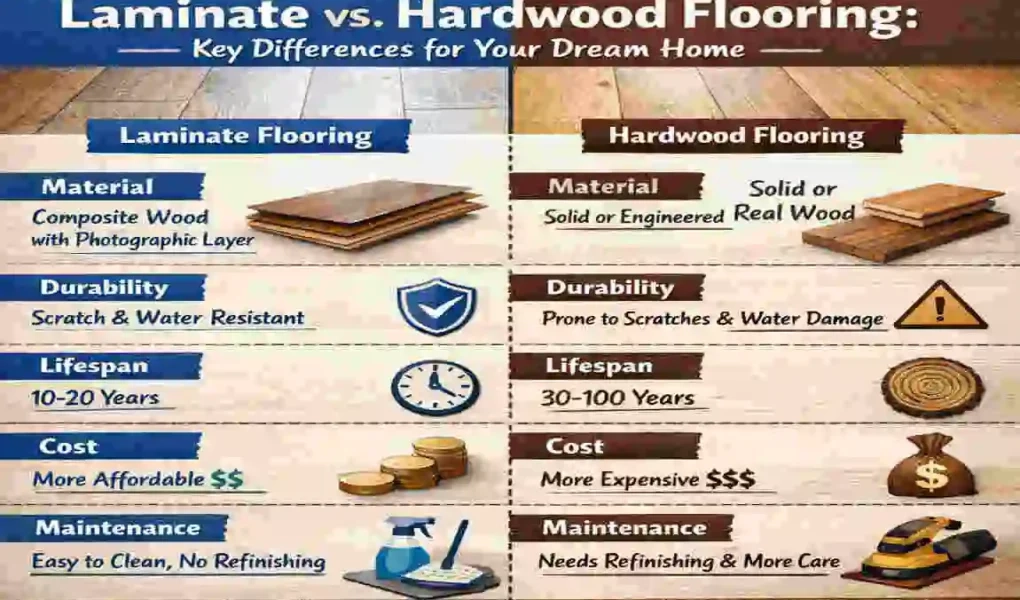
A well-maintained hardwood floor can last 50, 75, even 100 years. And here is the kicker: you can refinish it. Scratched it? Sand it down. Hate the color? Stain it darker. Want a matte look instead of glossy? Buff it out. You can change its personality three or four times over its life. This adds real resale value to your home. In 2026, buyers still swoon over genuine hardwood. It’s a selling point. It signals quality.
Laminate has a shelf life. Once that top wear layer is scratched through, or the locking mechanism fails, it’s done. You can’t sand it. You can’t refinish it. Most quality laminate lasts 15 to 25 years. After that, it goes to the landfill. So, while laminate is cheaper upfront, you might replace it twice in the time a single hardwood floor lasts. If you plan to stay in your home for thirty years, hardwood might actually be cheaper per year of use. But if you’re flipping the house in two years, laminate gives you the look without the long-term commitment. Don’t just look at the price tag today. Look at the cost per year of beauty.
Mistake 4: Falling for the "Perfect" Photo vs. Real-Life Texture
We live in an Instagram world. Everything looks flawless online. But floors are tactile. You walk on them. You touch them.
Hardwood has natural variation. No two planks are identical. There are knots, mineral streaks, and color shifts. This is called character. Some people love it; some hate it. But it’s real. It feels warm. It has depth. When light hits it, it reflects differently across the grain. It feels substantial.
Laminate is a photograph. Literally. It’s a high-resolution image of wood printed on paper, sealed under plastic. In the past, it looked fake. Flat. Shiny in a weird way. Today, technology like "embossed-in-register" means the texture matches the image. If there’s a knot in the picture, there’s a dent in the texture. It’s impressive. But it’s still repeating. In a small room, you might notice the same pattern every few feet. It can feel a bit… sterile. Cold. People often mistake the visual appeal for the sensory experience. Go to a showroom. Take off your shoes. Kick the sample. Does it sound hollow? Does it feel plasticky? Hardwood sounds solid. Laminate sounds like… well, laminate. Don’t choose with your eyes alone. Choose with your feet.
Mistake 5: Overlooking Maintenance and Repair Differences
Everyone thinks hardwood is high maintenance. It’s not. It’s just different maintenance. And laminate isn’t zero maintenance, though it’s close.
With hardwood, you avoid water. You use specific cleaners. You put felt pads on furniture legs. If you drag a chair, it scratches. But here’s the thing: minor scratches blend in. They become part of the patina. A dent from a dropped toy? It’s a story. You don’t panic. You just live with it. It ages gracefully.
Laminate is tough against stains. Wine, coffee, pet accidents—they wipe up easily. But it’s brittle. If you drop a heavy cast-iron skillet, it might chip or crack the edge. And you can’t fix that one plank easily. Often, you have to take apart half the room to replace a single board in the middle. It’s a puzzle. Hardwood repairs are localized. You can spot-sand and touch-up a small area. Laminate repairs are structural. Also, laminate can fade in direct sunlight over time. Hardwood changes color too, usually darkening or ambering, but it tends to be more uniform. Think about your lifestyle. Do you have big dogs with sharp nails? Laminate’s wear layer handles claws better than soft oak. Do you host dinner parties with red wine? Laminate wins. Do you hate the idea of replacing the whole floor in 20 years? Hardwood wins.
So, how do you decide? It comes down to priorities. There is no "best" floor. There is only the best floor for you.
Ask yourself these questions. Be honest.
- Budget: Can you afford the higher upfront cost of hardwood, including installation? Or do you need to spread the cost out over time?
- Timeline: How long will you stay in this home? If it’s less than ten years, laminate might make more financial sense. If it’s forever, hardwood pays dividends.
- Lifestyle: Do you have pets, kids, or a tendency to spill? Laminate is forgiving of accidents but not impacts. Hardwood is forgiving of impacts (to a degree) but not water.
- Aesthetics: Do you want the unique, authentic look of natural wood? Or are you okay with a consistent, uniform appearance?
- DIY Skill: Do you want to install it yourself? Laminate is friendly. Hardwood is not.
In 2026, the gap between the two is narrower than ever. High-end laminate looks incredibly realistic. Budget-friendly engineered hardwood is more stable than ever. But the core differences remain. One is a living, breathing material that ages with you. The other is a engineered product designed for convenience and durability.
Don’t let the salesperson rush you. Don’t let the online reviews scare you. Take samples home. Put them in your kitchen. Spill some water on them. Drag a chair across them. See how they look in the evening light.
Your floor is the foundation of your home’s vibe. It sets the tone. Whether you choose the timeless elegance of hardwood or the practical resilience of laminate, make sure it’s a choice you understand. Not just a choice you made because it looked good on Pinterest. You’ve got this. And your feet will thank you.