You know that feeling when you’re standing in the hardware aisle, staring at a wall of light bulbs, and your brain just kinda shuts off? It’s not just you. Lighting has gotten weirdly complicated. Back in the day, you bought a 60-watt bulb and called it a day. Now? You’re decoding letters and numbers like you’re trying to crack a secret code. G25. G30. G40. What does it even mean? And why does it matter if you’re just trying to make your bathroom mirror look nice?
Here’s the thing. The letter "G" stands for Globe. Simple enough. But the number? That’s the diameter in eighths of an inch. Wait, don’t run away. It sounds math-heavy, but it’s actually pretty straightforward once you see it. In 2026, with LED tech being the standard, getting the size right isn’t just about whether it fits in the socket. It’s about vibe. It’s about proportion. A bulb that’s too small looks cheap and lost. A bulb that’s too big looks clunky and overwhelming.
Let’s cut through the noise. We’re going to look at the three most common globe sizes you’ll run into today: the G25, the G30, and the G40. We’ll talk about where they belong, how big they actually are, and why picking the wrong one might ruin that cozy aesthetic you’ve been pinning on Pinterest for months. No jargon. No sales pitch. Just the facts, wrapped in a little bit of real-world advice.
Decoding the Numbers: What G25, G30, and G40 Actually Mean
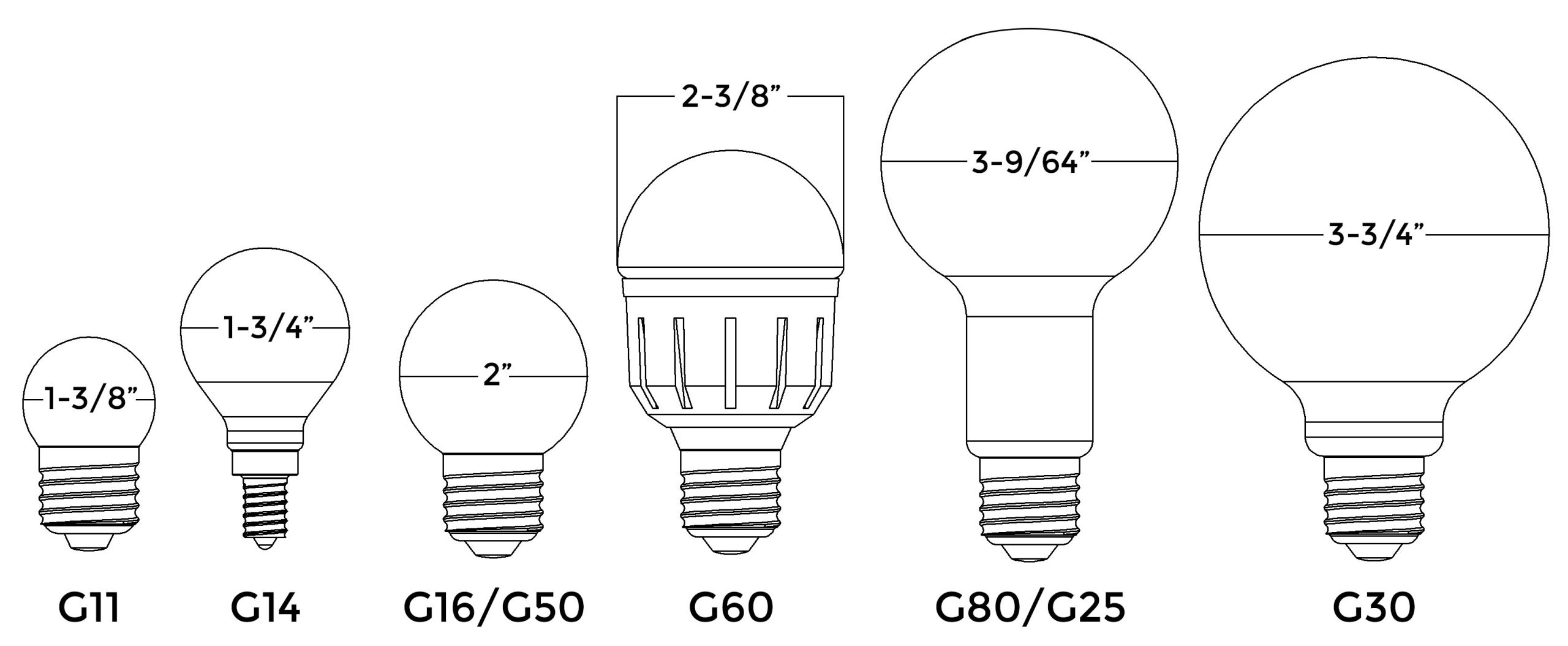
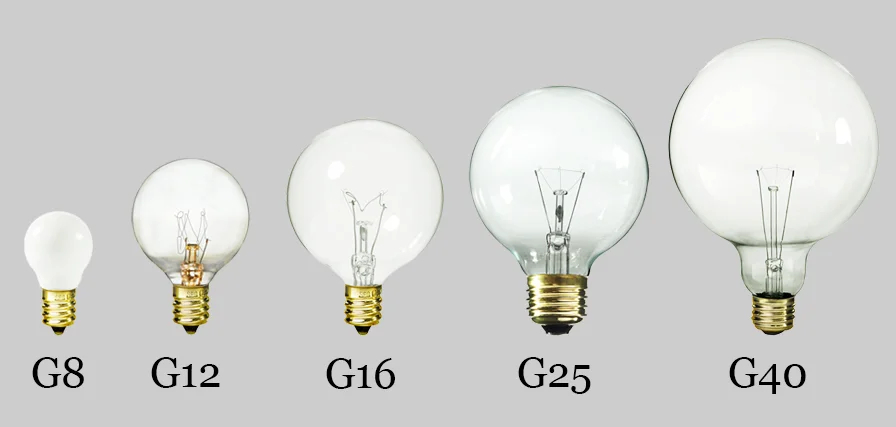
First things first. Let’s clear up the confusion about what those numbers represent. It’s not millimeters, and it’s not centimeters. It’s eighths of an inch. So, a G25 bulb is 25/8 inches in diameter. If you do the math (or just trust me on this), that comes out to roughly 3.125 inches. A G30 is 30/8 inches, which is 3.75 inches. And a G40? That’s 40/8 inches, or exactly 5 inches.
Why does this old-school measurement system still exist? Honestly, habit. The lighting industry moves slow. But knowing these actual dimensions is crucial because "medium" and "large" are subjective. My medium might be your large. But 3.1 inches is always 3.1 inches. In 2026, most packaging will list both the G-code and the metric equivalent (like 80mm for G25), but the G-code is what you’ll see on the box front.
Think of it like shoe sizes. You wouldn’t buy shoes based on whether they look "kinda big" in the box. You need the number. Same with bulbs. If your fixture has a tight cage or a specific shade, that half-inch difference between a G25 and a G30 can be the difference between a perfect fit and a bulb that won’t screw in all the way. Or worse, a bulb that touches the glass shade and overheats. Nobody wants that.
The G25: The Vanity Workhorse
The G25 is the unsung hero of the bathroom world. At roughly 3.1 inches across, it’s compact but still has that classic round shape we associate with vintage-style lighting. It’s not tiny like a candle bulb, but it’s not shouting for attention either. This is why you see it everywhere in vanity light strips. You know, those rows of three or four lights above your mirror? That’s G25 territory.
Why does it work so well there? Proportion. When you have multiple bulbs lined up close together, you don’t want them touching. A G25 gives you enough space between sockets so the fixtures don’t look crowded. Plus, it provides a nice, even spread of light for your face without creating harsh shadows. In 2026, LED G25s are super efficient. You can get a warm, soft glow (around 2700K) that makes your skin look good, not washed out.
But don’t limit it to the bathroom. G25s are great in small pendant lights over a kitchen sink or in a bedside sconce. They’re subtle. If you have a fixture with a narrow opening or a delicate design, the G25 won’t overwhelm it. It sits nicely inside most standard glass shades. Just remember, because it’s smaller, it might not throw light as far as its bigger cousins. It’s task lighting, not ambient flooding.
The G30: The Goldilocks Choice
Then there’s the G30. At 3.75 inches, it’s the middle child. Not too small, not too big. Just right? Sometimes. The G30 is often overlooked, but it’s having a moment in 2026. Why? Because interior design trends are shifting toward slightly more substantial fixtures without going full-on industrial. The G30 offers a bit more visual weight than the G25.
You’ll often find G30s in single pendant lights hanging over a dining table or in a small chandelier. They fill out the space better than a G25 would. If you have a fixture with a wider shade or an open cage design, the G30 looks more intentional. It doesn’t look like you grabbed the smallest bulb available. It looks like you chose it.
The light distribution is also a step up. Because the surface area is larger, a G30 LED can disperse light more evenly than a G25 of the same wattage. This makes it a solid choice for living rooms or hallways where you want a bit more glow. It’s versatile. It works in bathrooms too, especially if you have a larger mirror or fewer bulbs. Just check your fixture clearance. That extra half-inch matters if your shade is snug.
The G40: Making a Statement
Now we’re getting into the big leagues. The G40 is 5 inches in diameter. That’s the size of a grapefruit. Or, as some sources note, roughly the size of a ping pong ball (though actually, ping pong balls are smaller, around 40mm, which is confusingly where the name comes from historically, but modern G40s are definitely 5 inches/125mm). Regardless of the naming quirks, this bulb is visible. You can’t ignore it.
G40s are perfect for statement pieces. Think large chandeliers in entryways, oversized pendants over a kitchen island, or exposed bulb fixtures in a dining room. In 2026, the trend for "visible filament" LEDs is still strong, and the G40 gives those filaments room to breathe. The intricate loops and swirls of the LED filament look much better in a G40 than in a cramped G25. It’s art, basically.
But be careful. A G40 in a small bathroom vanity? It’ll look comical. It’ll crowd the mirror. And in outdoor string lights, G40s are popular for patios because they provide a good amount of brightness without being as massive as the G50 party bulbs. They strike a balance between decorative and functional. If you’re lighting a backyard dinner spot, G40s on a string create a warm, inviting canopy that feels intimate but still bright enough to see your food.
Fit, Finish, and Fixture Compatibility
Okay, so you’ve picked a size. But will it fit? This is where people mess up. It’s not just about the diameter. It’s about the total length of the bulb and the base type. Most G25, G30, and G40 bulbs use a standard E26 base (the regular screw-in kind in the US). But some smaller or decorative fixtures might use an E12 candelabra base. Always check the base before you buy. Nothing worse than getting home and realizing you need an adapter.
Then there’s the length. Globe bulbs aren’t perfectly spherical; they have a neck. A G40 can be quite long. If you have a pendant light with a short cord or a shade that sits close to the socket, a G40 might stick out the bottom or hit the top. Measure your fixture. Leave at least an inch of clearance on all sides for heat dissipation, even with LEDs. They run cooler than incandescents, but they still generate some heat, and trapped heat kills LED drivers faster.
Also, consider the finish. Clear glass shows off the filament and creates sparkly, directional light. Opal or frosted glass diffuses the light, making it softer and hiding the internal components. For a G25 in a vanity, opal is usually better to avoid glare in your eyes. For a G40 chandelier, clear glass adds that glamourous sparkle. In 2026, you can even find tinted globes (amber, smoke) that add mood without changing the bulb size. Just make sure the tint doesn’t make the light too dim for your needs.
Let’s talk about the pitfalls. The biggest mistake? Mixing sizes in the same fixture. Unless you’re going for a very specific, eclectic look, don’t put a G25 next to a G40 in a multi-light chandelier. It looks accidental, not designed. Stick to one size per fixture for a clean, cohesive look. Consistency is key to professional-looking lighting.
Another error is ignoring lumens. Just because a G40 is bigger doesn’t mean it’s brighter. It just has more surface area. You can have a dim G40 and a bright G25. Check the lumen output on the box. For a vanity, you want around 300-400 lumens per bulb. For a pendant over a table, maybe 600-800. Don’t guess. Read the label. In 2026, LED efficiency is so high that wattage is almost irrelevant. Focus on lumens and color temperature (Kelvin).
Lastly, don’t forget about dimmers. Not all LEDs are dimmable. And even if they are, they might not work with your old dimmer switch. If you’re installing globe bulbs in a room where you want to adjust the mood, make sure the bulb says "dimmable" and check if your switch is compatible. Flickering lights are not the vibe you’re going for. It’s a small detail, but it makes a huge difference in how much you enjoy your space.
Choosing the right globe bulb isn’t rocket science, but it’s not nothing either. It’s about paying attention to the details. The G25 for subtlety and tight spaces. The G30 for balance and versatility. The G40 for impact and style. Measure your fixtures. Check your bases. Think about the light you need, not just the look.
When you get it right, you barely notice the bulbs. You just notice that the room feels better. The light is soft where it should be, bright where it needs to be, and the fixtures look like they were made for those specific bulbs. That’s the goal. It’s not about the tech. It’s about how the tech makes your home feel.
So next time you’re in that aisle, take a second. Look at the numbers. Visualize the size. And pick the one that fits your space, not just the socket. Your eyes (and your guests) will thank you.