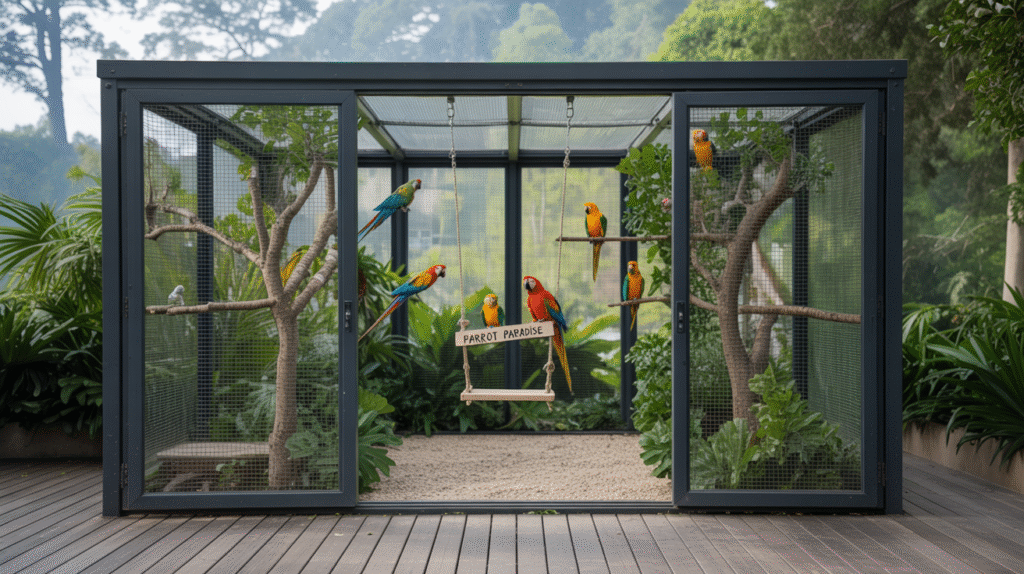
Ever looked at that empty corner in your living room or that awkward patch of backyard and thought, "What if?" What if it wasn’t just dead space? What if it was a jungle? A sky? For bird owners, the dream isn’t just a cage. It’s freedom. But let’s be real. Most of us don’t have acres of land or a spare wing on our mansion. We have apartments. We have modest backyards. We have tight budgets.
Does that mean your feathered friends are stuck in a box? Absolutely not. In fact, some of the most breathtaking avian sanctuaries I’ve seen in 2026 are tucked into spaces no bigger than a walk-in closet. The trick isn’t having more room. It’s using the room you have with intention, creativity, and a deep understanding of what makes a bird feel safe, loved, and free. This isn’t about squeezing them in. It’s about expanding their world vertically, visually, and emotionally. Let’s dive into how you can build a luxury experience for your parrots and finches, even if you’re working with inches instead of feet.
Rethinking Dimensions: Vertical Space is Your Best Friend
When floor space is scarce, you have to look up. Literally. Birds don’t care about square footage the way we do. They care about cubic volume. A parrot doesn’t need to run a marathon across the floor; they need to flap, climb, and glide. In 2026, the trend in small-space aviary design has shifted heavily toward verticality. Think of your aviary not as a room, but as a tree.
Start by maximizing height. If you’re building indoors, an 8-foot ceiling is your golden ticket. Even in a 4×4 foot footprint, an 8-foot height creates 128 cubic feet of airspace. That’s enough for a conure to stretch its wings fully or for a flock of finches to dart around without colliding. Use multi-tiered perching stations. Don’t just put one branch across the middle. Create levels. High branches for sleeping and observing (birds love being above everything), mid-level branches for socializing, and lower platforms for foraging. This layering prevents conflict, especially if you’re mixing species like parrots and finches. The parrots can claim the high ground, while the finches flit through the lower and middle zones. It’s a simple trick, but it turns a cramped box into a complex, interesting landscape.
Also, consider the visual perception of space. Mirrors are a no-go (they cause stress and aggression), but reflective surfaces used strategically on the outside of the mesh can make the enclosure feel twice as large. Light-colored backgrounds help too. A dark green backdrop might look natural, but it shrinks the space. A soft sky-blue or neutral beige opens it up. Remember, you’re designing for their eyes, not just their bodies. Every inch of vertical space should offer something new to explore, chew, or perch on.
The Great Divide: Safely Housing Parrots and Finches Together
Here’s the million-dollar question: Can parrots and finches live together? The short answer is… it’s complicated. The long answer is yes, but only if you respect their differences. Parrots are big, strong, and curious. Sometimes, that curiosity looks like a bite. Finches are tiny, fast, and fragile. One "playful" nip from a cockatiel can break a finch’s leg. So, how do you create a shared luxury space without turning it into a danger zone?
The key is separation within unity. You can have a single walk-in structure, but it needs internal partitions. Think of it like a duplex. Use double-layered mesh between the parrot side and the finch side. Why double? Because a determined parrot can reach through a single layer of wire mesh and grab a finch toe. A double layer creates a buffer zone—a no-man’s-land that claws and beaks can’t cross. This allows both species to see and hear each other, which provides social stimulation, but keeps them physically safe. It’s about community, not contact.
If you have the space, consider a "flight path" design. This involves a long, narrow corridor that connects two larger rooms—one for parrots, one for finches. The corridor acts as a neutral zone. Some owners even use sliding doors to allow supervised, free-flight interaction in a larger common area, then separate them when unsupervised. But for most small-space setups, the partitioned walk-in is the safest bet. Ensure the mesh gauge is appropriate for the smallest bird. For finches, you need 1/2 inch or smaller mesh. For parrots, 1 inch might work, but if they share the structure, go with the finer mesh everywhere. It’s better to be safe than sorry. And always, always provide separate food and water stations to prevent resource guarding.
Materials That Matter: Safety Meets Style
Let’s talk about what you’re actually building with. In the past, people used whatever wood and wire they had lying around. Big mistake. Birds chew. They poop. They scratch. Your materials need to be non-toxic, durable, and easy to clean. In 2026, the standard for luxury aviaries has risen. We’re not just talking about function; we’re talking about aesthetics. You want this thing to look good in your home or garden.
For the frame, avoid pressure-treated lumber. The chemicals used to preserve it (like copper azole or alkaline copper quaternary) are toxic to birds if ingested. Instead, opt for untreated cedar, redwood, or pine. Cedar and redwood are naturally resistant to rot and insects, making them great for outdoor setups. If you’re indoors, kiln-dried pine is affordable and safe, provided you seal it with a non-toxic, water-based polyurethane or leave it raw. Powder-coated steel is another excellent option for frames. It’s sleek, modern, and impervious to chewing. Plus, it looks incredibly chic.
For the mesh, stainless steel is the gold standard. Yes, it’s expensive. But galvanized wire can zinc toxicity if birds chew off the coating. Stainless steel lasts forever, doesn’t rust, and looks pristine. If budget is a concern, use stainless steel for the lower three feet where birds are most likely to chew, and galvanized wire for the upper sections. Just make sure the galvanized wire is heavy-duty and welded, not woven, to prevent unraveling. And don’t forget the floor. A removable tray lined with butcher paper or sand makes cleanup a breeze. For a luxury touch, consider a false floor made of smooth, sealed stone or tile that slopes slightly for drainage if it’s an outdoor unit. It feels spa-like for you when you’re cleaning, and it’s hygienic for them.
Lighting and Atmosphere: Creating a Natural Rhythm
Birds are creatures of light. Their hormones, mood, and health are dictated by the sun. In a small indoor aviary, you’re cutting them off from the natural world. You have to bring that world inside. This isn’t just about seeing; it’s about feeling. Full-spectrum UV lighting is non-negotiable. Birds need UVB rays to synthesize Vitamin D3, which helps them absorb calcium. Without it, they get weak bones and brittle feathers. In 2026, LED grow lights designed for avians are more energy-efficient and less hot than older bulbs. Install them on a timer to mimic the natural photoperiod of your region. If you’re in Seattle, your birds need different light hours than if you’re in Miami.
But light is also about mood. Harsh, direct overhead lighting can be stressful. Use diffusers or aim lights at walls to create a soft, ambient glow. Add shadows. Birds love shadows. They provide hiding spots and a sense of security. Incorporate plants—real ones, if they’re non-toxic (like spider plants, pothos, or ferns), or high-quality silk ones if you’re worried about mess. Plants break up sightlines, add humidity, and make the space feel alive. A lush, green aviary feels like a sanctuary. A bare, white box feels like a clinic.
Don’t forget sound and air flow. Stale air breeds disease. Install a quiet exhaust fan or ensure there’s cross-ventilation. But avoid direct drafts on the perches. Birds hate being blown on while they sleep. As for sound, consider a small, hidden speaker playing gentle nature sounds—rainforest ambience, soft wind, distant bird calls. It masks household noises (like vacuum cleaners or slamming doors) that can startle them. It’s the little touches that turn a cage into a retreat.
Enrichment on a Budget: Luxury Doesn’t Mean Expensive
Luxury isn’t about gold-plated perches. It’s about engagement. A bored bird is a destructive bird. In a small space, enrichment is critical because they can’t just fly away to find fun. You need to rotate toys, textures, and activities. The good news? Some of the best enrichment items are free or cheap. Cardboard boxes, paper towel rolls, and untreated wicker baskets are fantastic for shredding. Parrots love to destroy things. It’s natural behavior. Give them permission to do it.
For finches, enrichment is about exploration. Add cuttlebones, mineral blocks, and sprays of millet. Hide treats in foraging toys. Change the layout of the perches every few weeks. Move a swing to the other side. Add a new branch from a safe tree (like apple or willow). Novelty keeps their brains active. In 2026, we’re seeing a rise in "smart" enrichment—simple puzzles that release treats when manipulated. But don’t overlook the basics. A shallow dish of water for bathing is pure luxury for a finch. A misting system on a timer can simulate a tropical rain shower. It’s refreshing, cleans their feathers, and lowers dust levels.
Involve yourself in the enrichment too. Spend time in the aviary. Sit on a stool. Read a book. Let them get used to your presence without demanding interaction. This builds trust. For parrots, target training with clicks and treats can be done right in the aviary. It strengthens your bond and gives them mental work. Remember, the goal is to create a dynamic environment that changes with the seasons and their interests. A static space is a dull space. Keep it fresh, keep it interesting, and watch their personalities bloom.
Let’s be honest. Bird keeping is messy. Poop everywhere. Feathers floating like snow. Food hulls in every corner. If you don’t stay on top of hygiene, your luxury aviary becomes a health hazard quickly. Ammonia from droppings can damage their respiratory systems. Mold from wet food can kill them. So, how do you keep it pristine without spending your entire life scrubbing?
Design for cleaning. This goes back to materials. Smooth surfaces wipe down easily. Rough wood traps bacteria. Removable trays are essential. Line them with newspaper or butcher paper and swap them out daily. For the mesh, a handheld steam cleaner is a game-changer. It sanitizes without chemicals and blasts away caked-on grime. Do a quick spot-clean every day. Pick up obvious messes. Replace soiled water. Toss out uneaten fresh food. Then, do a deep clean once a week. Take everything out. Scrub the perches. Wash the bowls in hot, soapy water. Wipe down the walls.
Prevention is easier than cure. Keep the aviary dry. Humidity is good for feathers, but dampness is bad for lungs. Ensure good ventilation. Use absorbent substrates if you have a solid floor. And monitor your birds. Are they sneezing? Is their poop weird? These are signs that something’s off with the environment. Regular vet check-ups are part of maintenance too. A healthy bird is a happy bird. By staying proactive, you ensure that your small space remains a haven, not a hazard. It’s a bit of work, sure. But seeing them thrive makes it worth every minute.
So, there you have it. Transforming a small space into a luxurious walk-in aviary isn’t about having a huge budget or a massive yard. It’s about thinking vertically, respecting species differences, choosing safe materials, creating a natural atmosphere, providing endless enrichment, and staying on top of cleanliness. It’s about love, translated into wood, wire, and light. Whether you’re housing a single cockatiel or a mixed flock of finches and conures, you can give them a life that’s rich, safe, and beautiful. Start small. Dream big. And remember, the best aviary isn’t the biggest one. It’s the one where your birds feel most alive.