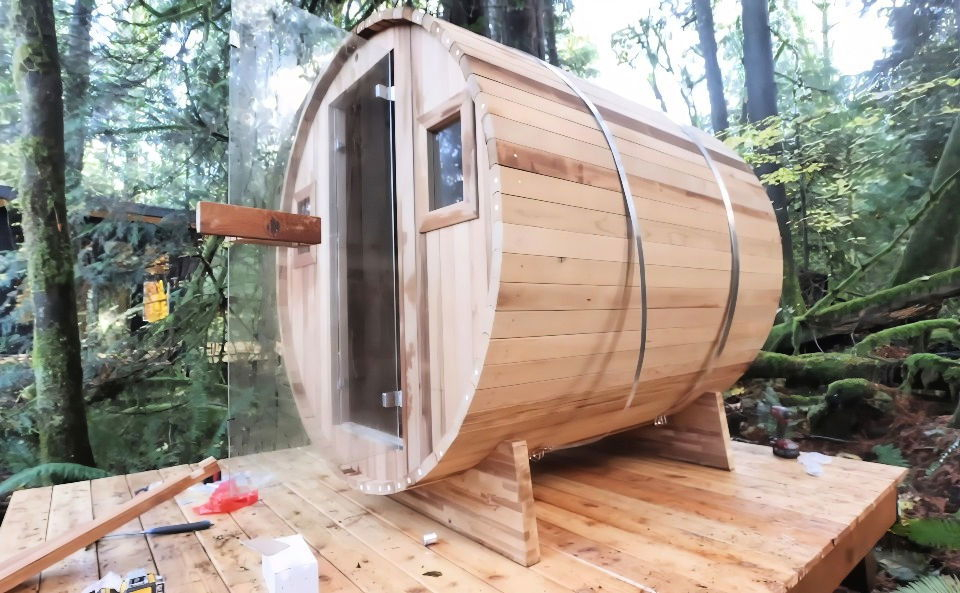
You know that feeling when you’re standing in your backyard, shivering slightly in the crisp morning air, just waiting for the sauna to get hot? It’s a test of patience. We’ve all been there. You check your watch. You kick at the grass. You wonder if the heater is even on. In 2026, with our busy lives and the desire for instant gratification, nobody wants to wait an hour to start sweating. That’s exactly why the humble barrel sauna has surged back into the spotlight. It’s not just a rustic aesthetic choice anymore; it’s a thermodynamic hack.
While the traditional square cabin has its charms—mostly nostalgia and extra elbow room—it’s essentially fighting against physics. The barrel, with its curved walls and lack of corners, works with the natural flow of heat. It’s smarter. It’s quicker. And for the average homeowner looking to squeeze in a session before work or right after dinner, those minutes saved add up to a lot more actual relaxing time. Let’s dig into why shape matters so much more than we thought.
The Convection Current Advantage
Heat doesn’t just sit there. It moves. Specifically, hot air rises. This is basic stuff, right? But in a square room, that rising hot air hits the flat ceiling and then gets stuck. It creates stagnant pockets in the upper corners where the heat just hangs out, doing nothing useful for your body. You end up with a layer of scorching air near the roof and cooler air down by your feet. It’s uneven. It’s inefficient.
Now, picture that same hot air inside a cylinder. As it rises, it hits the curved wall and naturally rolls over, creating a continuous loop. This is called natural convection, and the barrel shape is basically a masterclass in it. The curved interior directs the airflow in a uniform circulation pattern. There are no sharp corners for the heat to hide in. Instead, the air keeps moving, mixing, and distributing warmth evenly from top to bottom.
This constant motion means the entire volume of air reaches your target temperature much faster. According to recent data from ThermalFinn, this specific airflow dynamic allows barrel saunas to heat up approximately 20-25% faster per cubic foot than an equivalent uninsulated rectangular cabin. It’s not magic; it’s just fluid dynamics working in your favor. The air is constantly being recycled through the heater zone, picking up more energy with every pass.
Surface Area and Heat Loss
Here’s a counterintuitive fact: a sphere (or a cylinder, which is close enough for our purposes) has the smallest surface area for a given volume. Think about it. If you have a certain amount of space inside, a boxy shape requires more wood to enclose it than a round shape does. More wood means more surface area exposed to the cold outside air. And more surface area means more places for heat to escape.
In 2026, energy efficiency isn’t just a buzzword; it’s a necessity. Every square inch of exterior wall on a cabin sauna is a potential leak for thermal energy. The barrel minimizes this exposure. By reducing the total surface area, you reduce the rate at which heat transfers from the inside to the outside. This is particularly crucial for outdoor saunas that aren’t heavily insulated. Most barrel saunas rely on the thickness of the staves rather than thick batts of fiberglass, so minimizing that exposure is key.
SweatDecks analyzed specifications from 15 different manufacturers and found that this geometric efficiency contributes significantly to the overall speed. While cabin saunas might offer 40% more interior space for the same footprint, they pay for that luxury with slower heat-up times. The barrel’s compact, rounded exterior acts like a thermal shield, keeping the warmth where it belongs: inside, surrounding you. It’s a tighter ship, thermally speaking.
The "Dead Corner" Problem
Let’s talk about corners. In architecture, corners are often seen as structural necessities. In sauna design, they are thermal dead zones. When you build a square or rectangular cabin, you create four vertical corners. These spaces are notoriously difficult to heat evenly. The air circulation slows down there. The heat doesn’t penetrate as deeply. You end up with cold spots that drag down the average temperature of the room.
To compensate for these cold corners, your heater has to work harder and longer. It has to pump out excess heat to ensure that the center of the room—and your bench—is warm enough. It’s like trying to fill a leaky bucket; you have to keep pouring water in just to maintain the level. The barrel sauna eliminates this problem entirely. There are no corners. The wall is a continuous curve.
This absence of dead zones means the heater’s output is used much more effectively. Every bit of energy goes into heating the usable air space. TopTure’s 2026 comparison guide highlights that this efficiency translates to heat-up times that are 30-45% faster in many real-world scenarios. You aren’t wasting energy trying to warm up empty wooden corners that you’ll never sit in. You’re heating the air you actually breathe. It’s a simple design tweak with massive performance implications.
Material Thickness and Self-Sealing
Most barrel saunas are built using tongue-and-groove staves, usually made from cedar or hemlock. These staves aren’t just slapped together; they are engineered to fit tightly. But here’s the cool part: as the wood heats up, it expands. In a barrel structure, this expansion actually tightens the seal between the staves. It’s self-sealing. The hotter it gets, the tighter it becomes.
Square cabins often use panelized construction or thicker beams that don’t have this same dynamic tightening effect. They rely on static seals and insulation. While effective, they don’t benefit from the thermal expansion in the same way. The barrel’s design leverages the physical properties of wood to improve its own insulation during operation. This means that as the sauna approaches its peak temperature, it’s also becoming more efficient at holding that heat.
The Hans India noted in their 2026 trend report that this self-aligning feature of cedar staves makes assembly easier, but it also plays a role in performance. The tight fit reduces drafts. Drafts are the enemy of fast heating. Even a tiny breeze leaking in through a crack can cool down the room significantly. By minimizing these leaks through the natural expansion of the curved structure, the barrel maintains a stable, rapidly rising temperature. It’s a living building, in a sense.
Heater Sizing and Power Efficiency
Because barrels heat up faster, you can often get away with a smaller heater compared to a cabin of similar volume. Or, if you use the same sized heater, you reach your desired temperature in a fraction of the time. This is a huge deal for electricity bills and for the lifespan of your heating elements. Running a heater at full blast for 45 minutes is better than running it for 90 minutes.
In 2026, many homeowners are opting for electric heaters due to ease of installation. These units have power limits. A 6kW heater in a barrel sauna will bring the room to 180°F (82°C) much quicker than it would in a square cabin. This responsiveness is great for spontaneous sessions. You don’t have to plan your sauna day hours in advance. You can decide to sweat on a whim, turn it on, and be ready in under half an hour.
SaunaPlungeDirect’s buyer’s guide emphasizes this point: the barrel is designed for life, specifically the fast-paced modern life. The efficiency isn’t just about saving money; it’s about removing friction from the wellness routine. If it takes too long to get started, you’re less likely to do it. The barrel’s quick heat-up time removes that barrier. It makes the habit stick. And let’s be honest, a heater that doesn’t have to run as long is going to last longer too. Less wear and tear.
Let’s step back from the physics for a second and talk about how this fits into your actual life. Why does a 30-minute heat-up matter? Because time is the one resource we can’t buy more of. If you’re coming home from work at 6 PM, and you want to sauna before dinner, waiting an hour is a hassle. Waiting 30 minutes is manageable. You can change, prep your water, maybe read a few pages of a book, and then hop in.
The trend data from 2026 shows that people are prioritizing convenience alongside aesthetics. The barrel sauna’s smaller footprint also helps. It fits in tighter backyard spaces, which means it’s closer to the house. Shorter distance from the house means less heat loss while walking back and forth. It’s a holistic efficiency. You’re not just saving time on the heat-up; you’re saving time on the logistics.
TopTure points out that while cabins offer more space for changing rooms or porches, the barrel wins on pure speed and cost. For most people, the trade-off is worth it. You sacrifice a dressing area for the ability to use the sauna more often. It becomes a daily ritual rather than a weekend event. And honestly, isn’t that the goal? To integrate wellness into the everyday? The barrel’s design supports that frequency. It’s built for regular, quick, effective sessions.
So, what’s the verdict? If you have a massive estate and love the idea of a lounge area attached to your sauna, go for the cabin. But if you want heat, and you want it fast, the barrel is the clear winner. It’s not just a style statement. It’s a superior thermal machine. The combination of convection currents, reduced surface area, and lack of dead corners creates a perfect storm of efficiency.
In 2026, we’re seeing a shift away from purely decorative outdoor structures toward functional wellness tools. The barrel sauna fits this mold perfectly. It respects your time. It respects your energy bill. And it delivers that deep, penetrating heat we all crave without the long wait. Next time you’re shivering in the backyard, remember: the shape of the room is doing the heavy lifting. Let the curve work for you.
It’s funny how something as simple as rounding off the corners can change the whole experience. We often overcomplicate things, thinking bigger is better or more features mean more value. But sometimes, the best solution is the simplest one. Strip away the corners. Let the air flow. Keep the heat in. It’s ancient wisdom, wrapped in modern engineering. And it works.