So, you’ve got that unfinished basement space. Maybe it’s got some drywall up now, maybe it’s still just studs and dreams. But you know what you want: a place to escape. A spot where the outside world fades away and you’re lost in a movie, a game, or a big match. The question keeping you up at night isn’t about the popcorn machine (though that’s important). It’s the screen. Do you go with the traditional route of a massive television, or do you embrace the cinematic ritual of a projector?
It used to be an easy call. Ten years ago? If you wanted big, you bought a projector. If you wanted bright and easy, you bought a TV. But 2026 is a different beast entirely. The lines have blurred. You can now get TVs that are nearly ten feet wide, and projectors that can handle a bit of ambient light without washing out into a gray mess. It’s confusing, right? That’s why we’re here. Let’s cut through the marketing noise and look at what actually matters for your specific room, your wallet, and your sanity.
The Size Factor and Cost Per Inch
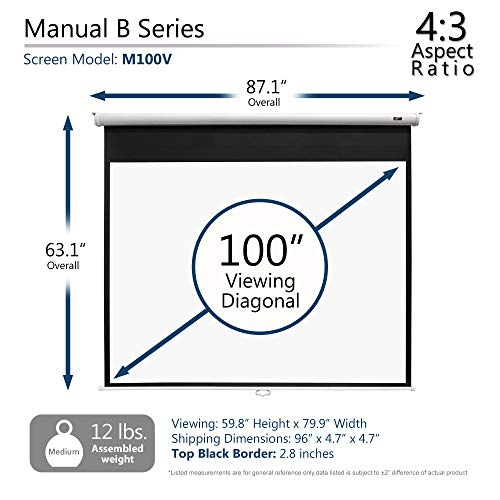
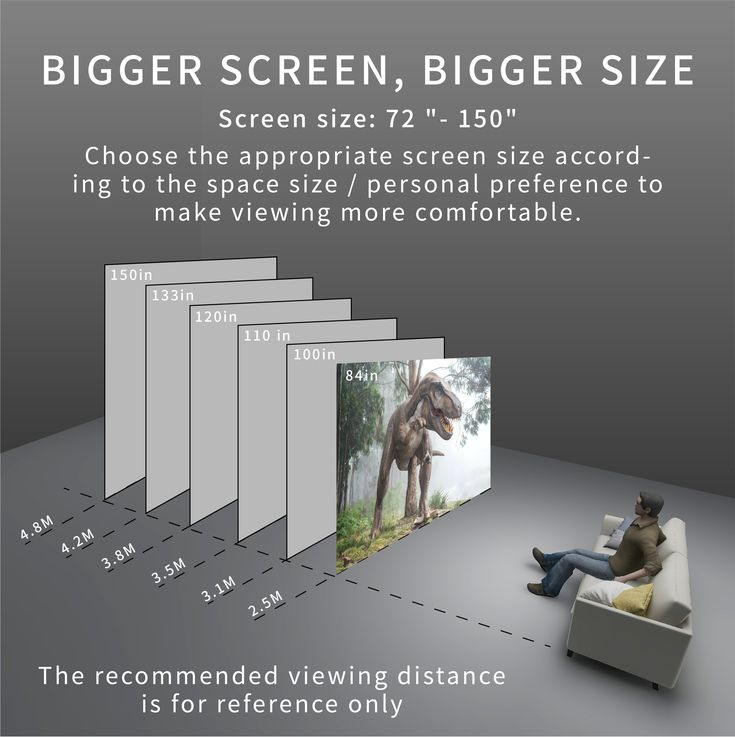
Let’s talk numbers, because this is usually where the decision gets made. If you crave that true "theater" feeling, size matters. A lot. In 2026, if you want a screen that is 100 inches or larger, a projector is still the undisputed king of value. You can put together a solid 4K laser projector and a high-quality fixed-frame screen for around $1,500 to $2,000. That gets you a massive, immersive image that fills your peripheral vision.
Now, look at the TV market. Sure, prices have dropped. You can find 85-inch TVs for reasonable prices. But once you cross that 98-inch threshold, the cost skyrockets. A 98-inch LED or Mini-LED TV in 2026 is still hovering around $4,000 or more. And if you want something bigger than that? Good luck finding it in an elevator, let alone affording it. For every inch above 100, the projector wins on pure cost efficiency. It’s simple math. If you have a large wall and a limited budget, projection gives you more bang for your buck.
But don’t just look at the sticker price. Think about the installation. A TV is heavy. A 98-inch panel can weigh over 100 pounds. Getting that into a basement often means renting a crane or taking out a window. A projector? It’s a small box. The screen is lightweight fabric or vinyl. You can carry them both down a narrow staircase with ease. If your basement access is tight, the logistics alone might make the projector the only viable option for a huge image.
Picture Quality: Contrast, Black Levels, and HDR
Here is where things get tricky. For decades, projectors struggled with black levels. They couldn’t turn off the light completely, so dark scenes looked gray. That’s changed, but has it caught up to OLED? Not quite. In 2026, OLED TVs remain the gold standard for contrast. Each pixel produces its own light, meaning when it’s off, it’s truly black. This creates an infinite contrast ratio that makes HDR (High Dynamic Range) content pop with incredible intensity.
Projectors have improved massively, especially with the rise of laser light sources. Laser projectors in 2026 offer much better color accuracy and brightness stability than the old bulb models. Some high-end models even use dynamic tone mapping to mimic HDR effects. But they still rely on reflecting light off a screen. Even the best "black" screens can’t absorb 100% of the light. So, in a direct head-to-head on a dark scene—say, a space movie with stars against a void—the OLED TV will look deeper, richer, and more three-dimensional.
However, context is everything. If you are watching sports or daytime TV, the superior brightness of a modern Mini-LED TV or a high-lumen laser projector might be more appealing than deep blacks. But for pure cinema lovers who watch movies in a controlled, dark environment, the TV’s ability to produce perfect blacks is a hard feature to give up. It’s the difference between looking at a picture and feeling like you’re in the scene. Ask yourself: do you prioritize absolute perfection in dark rooms, or are you okay with very good, but not perfect, contrast in exchange for size?
Lighting Conditions and Room Control
Basements are naturally darker, which is great for home theaters. But let’s be real. How often is your basement pitch black? Maybe you have a bathroom nearby. Maybe you have a bar area with under-cabinet lighting. Maybe your kids are playing video games in the corner while you watch a show. Ambient light is the enemy of projection. Or at least, it used to be.
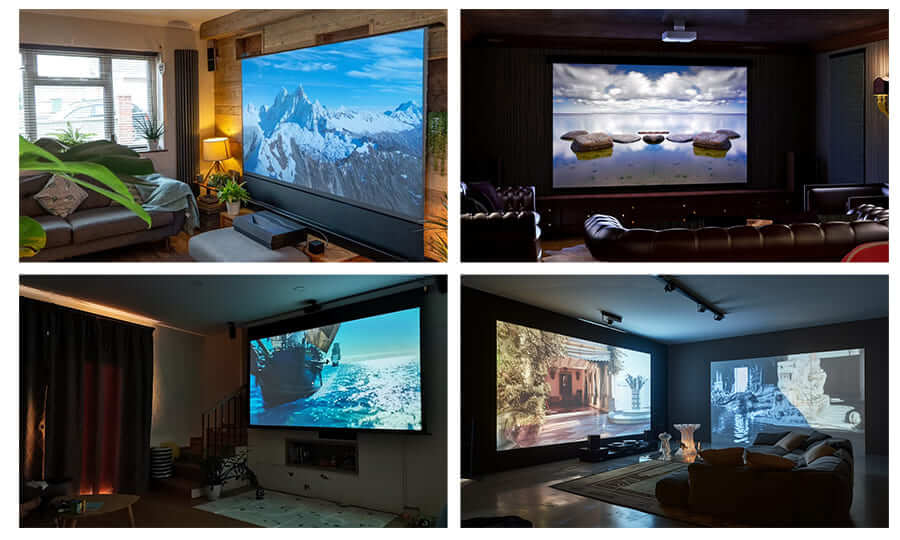
In 2026, Ultra Short Throw (UST) laser projectors have changed the game. These devices sit just inches away from the wall on a media console, shooting the image upward onto a specialized ALR (Ambient Light Rejecting) screen. These screens are engineered to reflect light back to the viewer while rejecting light from ceiling fixtures or windows. A good UST setup in 2026 can produce a viewable 100-120 inch image even with some lights on. It’s not as good as total darkness, but it’s usable.
TVs, on the other hand, are largely immune to ambient light. A high-brightness Mini-LED TV can pump out enough nits (brightness units) to cut through a well-lit room. If your basement is a multi-purpose space—a playroom, a gym, a hangout spot—a TV is far more versatile. You don’t have to dim the lights or close blinds. You just turn it on. If you plan to use the room during the day or with family activity happening around you, the TV’s resilience to light makes it the practical choice. Projectors demand respect; TVs just work.
Gaming Performance and Input Lag
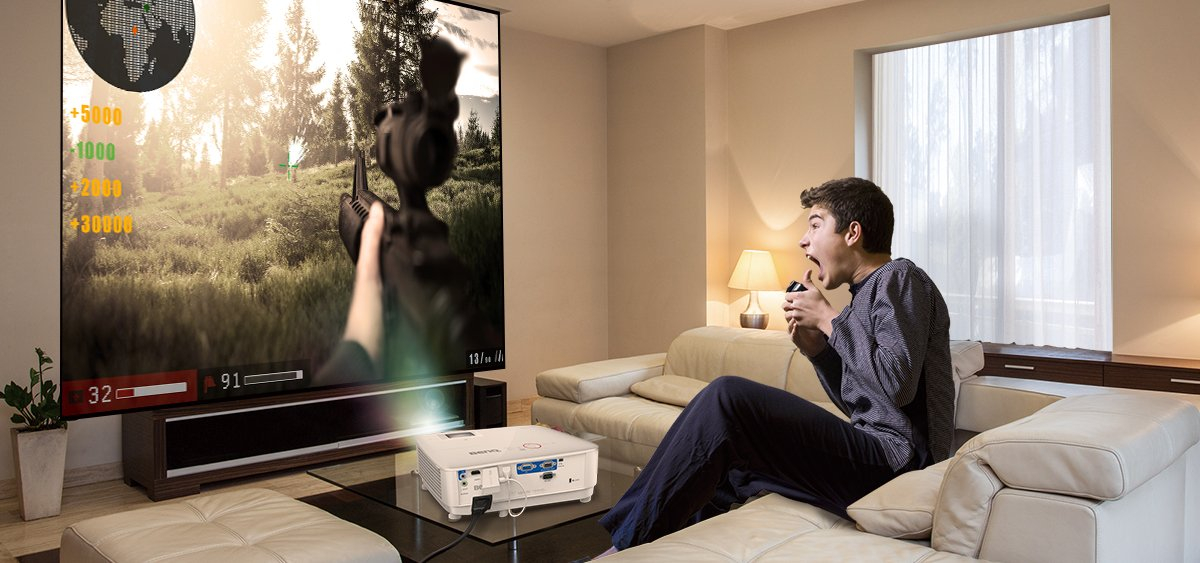
Gamers, this section is for you. The debate used to be that TVs were faster and projectors were laggy. In 2026, that gap has nearly vanished for high-end gear. Most modern 4K projectors, especially those marketed for home entertainment, support HDMI 2.1 and Variable Refresh Rate (VRR). This means they can sync with your PS5, Xbox Series X, or PC to eliminate screen tearing and stuttering. Input lag on decent 2026 projectors is often under 20ms, which is perfectly playable for most genres.
However, competitive gamers might still lean toward TVs. Why? Response time. OLED panels have near-instantaneous pixel response times, often under 1ms. This reduces motion blur significantly in fast-paced shooters or racing games. While projectors have improved, the physical process of processing the image and projecting it still introduces a tiny bit more latency than a direct-view panel. If you are playing casually, you won’t notice. If you are ranking up in a competitive online league, that millisecond edge matters.
Also, consider the size of the UI. On a 120-inch screen, reading small text in a game menu or spotting a tiny enemy in the distance can sometimes be harder than on a crisp, dense 85-inch TV. The pixel density on a large projected image is lower than on a similarly resolved TV viewed from the same distance. For immersion in RPGs or open-world adventures, the projector’s scale is unbeatable. For twitch-reflex competitive play, the TV’s precision holds the crown. Know what kind of gamer you are before you buy.
Installation, Maintenance, and Longevity
Let’s talk about the hassle factor. Installing a TV is straightforward. Mount it on the wall, plug it in, done. It’s a self-contained unit. Projectors require a bit more thought. You need to mount the unit (unless it’s a UST), run power, and ideally, run an HDMI cable through the ceiling or walls to keep things tidy. You also need to calibrate the image geometry so it’s a perfect rectangle. It’s not rocket science, but it’s not plug-and-play either.
Then there’s maintenance. Old bulb projectors needed new lamps every few thousand hours. Modern laser projectors in 2026 are rated for 20,000 to 30,000 hours. That’s basically the lifetime of the device. You won’t be changing bulbs. However, lenses can gather dust, and filters (if the model has them) need cleaning. TVs are virtually maintenance-free. You might wipe the screen down occasionally, but that’s it.
Longevity is another point. OLED TVs have a risk of burn-in if you leave static images on screen for thousands of hours. While 2026 models have excellent mitigation tech, it’s still a theoretical concern for heavy news watchers or HUD-heavy gamers. Projectors don’t have burn-in. Their laser light sources degrade very slowly over time. If you plan to keep this setup for 10+ years, a laser projector might actually outlast an OLED panel in terms of consistent performance, provided you keep it clean.
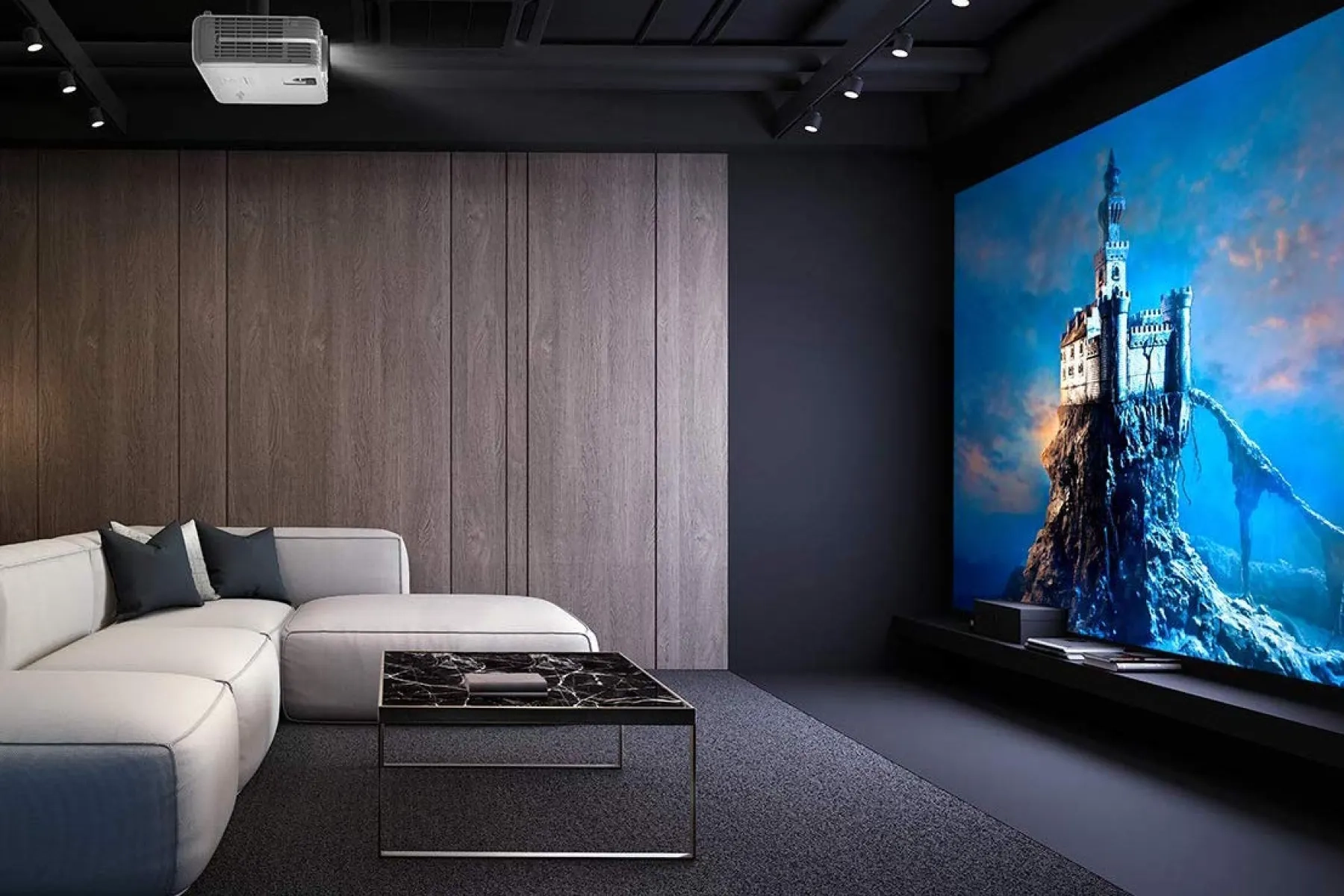
So, which one should you buy? There is no single right answer, but there is a right answer for you. If you have a dedicated, light-controlled room and you love the ritual of cinema—dimming the lights, hearing the fan whir, seeing a 120-inch image fill your view—go with a laser projector. Specifically, look at Ultra Short Throw models if you want a cleaner look without ceiling mounts. It’s about the experience. It’s about feeling small in front of something big.
If your basement is a chaotic, multi-use hub where the lights stay on, where kids run around, and where you want to watch sports during the day without fuss, get a big TV. An 85-inch or 98-inch Mini-LED or OLED will give you stunning picture quality, zero hassle, and brightness that fights back against the real world. It’s about convenience and consistency. It’s about turning on the entertainment without adjusting the environment.
Think about your seating too. If you sit close, a TV’s pixel density looks sharper. If you sit back, a projector’s large image feels more natural. Consider your budget not just for the screen, but for the room treatments. A projector budget should include money for blackout curtains or a good ALR screen. A TV budget is mostly just the TV itself. Both options in 2026 are incredible. You really can’t lose. You just have to decide what kind of nights you want to spend in that basement.