You plug in the cable. You hit the power button. And then… nothing. Or maybe, something weird. The screen flickers. The resolution drops. The refresh rate caps at a disappointing 60Hz when you paid for 144Hz. It’s frustrating, isn’t it? We’ve all been there. Standing behind our desks, tangled in a mess of wires, wondering why the tech we bought doesn’t just work.
It’s 2026. HDMI 2.1 has been around for a while now. It arrived on the scene with a lot of hype circa 2020, promising a huge leap forward. But here we are, six years later, and the conversation hasn’t exactly gotten simpler. In fact, with new graphics cards like the ROG Astral RTX 5090 finally bringing proper HDMI 2.1 support to the PC mainstream, the confusion has only deepened for some. Is it worth the hassle? Does the bandwidth actually change your life? Let’s cut through the noise.
The Bandwidth Boom: What 48Gbps Actually Means
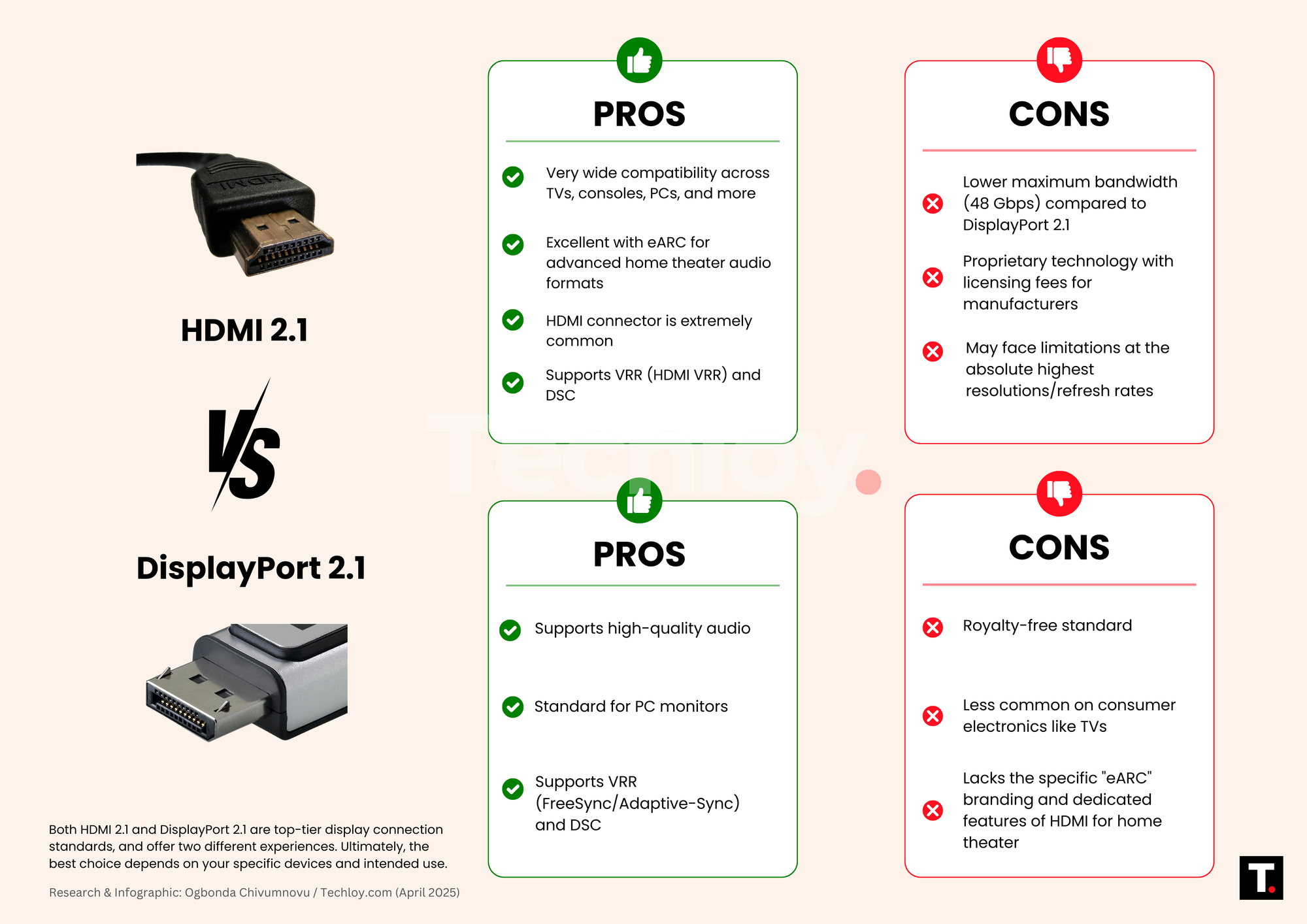
Let’s talk numbers, but keep it simple. HDMI 2.0, the old standard, could handle about 18 gigabits per second (Gbps). That was fine for 4K at 60Hz. But HDMI 2.1? It jumps up to 48 Gbps. That is a massive increase. Think of it like upgrading from a two-lane country road to a six-lane superhighway. More cars (data) can move at once, and they can move faster without causing a traffic jam.
Why does this matter for your PC? Well, if you are pushing high resolutions and high refresh rates, you need that space. 4K at 120Hz or even 144Hz requires a lot of data. Without that extra bandwidth, your computer has to compress the image, which can lead to visual artifacts or lag. Or worse, it just won’t let you turn on those settings at all. For gamers, this is the difference between a smooth, responsive experience and a choppy mess.
But it’s not just about raw speed. This bandwidth allows for features that were previously impossible over a single cable. We’re talking about dynamic HDR, which adjusts the picture scene-by-scene, and higher color depths. It makes the image pop. It makes games look more real. For the average user just watching Netflix, sure, HDMI 2.0 might still cut it. But for anyone wanting the best their monitor can offer, that 48Gbps pipeline is essential.
The Gaming Revolution: Smoothness You Can Feel
Gamers are the ones who benefit the most. There is no doubt about it. If you are playing competitive shooters or fast-paced action games, every frame counts. HDMI 2.1 introduced Variable Refresh Rate (VRR) as a standard feature. This syncs your monitor’s refresh rate with your graphics card’s output. No more screen tearing. No more stuttering. Just pure, fluid motion.
In the past, PC gamers relied heavily on DisplayPort for these high-end features. HDMI was seen as the "TV standard." But that changed. With revision 2.1, HDMI became a true competitor to DisplayPort 1.4. Now, you can get the same low-latency, high-refresh performance on a big OLED TV in your living room as you do on a dedicated gaming monitor. This flexibility is huge. It means you aren’t tied to your desk.
Take the recent rollout of cards like the RTX 5090. For the first time, we are seeing flagship GPUs with multiple full-bandwidth HDMI 2.1 ports. This wasn’t always the case. Earlier cards often had limited HDMI implementations. Now, you can hook up two 4K 120Hz displays via HDMI and still have headroom. It’s a game-changer for multi-monitor setups or for those who want to switch between a monitor and a large screen TV seamlessly.
The Cable Chaos: Why Your Wire Might Be the Problem
Here is where things get messy. You buy a new monitor. It says HDMI 2.1. You buy a new GPU. It says HDMI 2.1. You use the cable that came with your old TV from 2018. And it doesn’t work. Why? Because not all cables are created equal. To get the full 48Gbps, you need an "Ultra High Speed" HDMI cable. Look for that label. It’s not optional if you want the full feature set.
Standard copper HDMI 2.1 cables have limits too. They typically max out at around 3 meters, or about 10 feet, for reliable transmission. If you are trying to run a cable across a large room to a projector or a wall-mounted TV, a cheap copper wire might fail. You’ll get black screens or signal drops. It’s infuriating. In these cases, you need to look at fiber-optic HDMI 2.1 cables. They are more expensive, but they can go much longer distances without losing signal quality.
This is a common pitfall. People overspend on the monitor and the PC but skimp on the cable. Don’t do that. The cable is the bridge. If the bridge is weak, the traffic stops. Check your cables. If you are experiencing issues, swap them out for a certified Ultra High Speed one. It’s the cheapest fix for a lot of headaches. And remember, length matters. Keep it short if you can.
The Compatibility Nightmare: Not All Ports Are Equal
Just because a device says "HDMI 2.1" doesn’t mean it supports everything. This is the dirty secret of the industry. The specification includes a group of features, but manufacturers don’t have to implement all of them. Some might support 4K 120Hz but not VRR. Others might support eARC for audio but lack the full bandwidth for uncompressed video. It’s a minefield.
For example, eARC (enhanced Audio Return Channel) is a key HDMI 2.1 feature. It allows for higher quality audio to pass from your TV back to a soundbar or receiver. If you are building a home theater PC, this is crucial. But if you are just gaming on a monitor with built-in speakers, you might not care. You need to ask: What specific features do I need? Do I need 4K 120? Do I need VRR? Do I need eARC?
The confusion is real. Recent reports highlight that hooking up new PCs to HDMI 2.1 monitors can still be a nightmare due to these inconsistencies. Firmware updates often fix these issues, but it shouldn’t be this hard. Always check the detailed specs of both your GPU and your monitor. Don’t just rely on the "HDMI 2.1" logo. Look for the specific resolutions and refresh rates supported. It saves time and frustration.
Beyond Gaming: Productivity and Creative Work
It’s easy to focus on gaming, but HDMI 2.1 impacts other users too. If you are a video editor or a graphic designer, color accuracy and resolution are vital. The increased bandwidth allows for 10-bit and 12-bit color depth at higher resolutions. This means smoother gradients and more accurate colors. For professional work, this isn’t just a nice-to-have; it’s a requirement.
Imagine editing 8K video. Without HDMI 2.1, you might be stuck with compressed signals or lower refresh rates, making the workflow sluggish. With the full bandwidth, you can scrub through timelines smoothly. You can see the true colors of your footage. It makes the job easier and more precise. Even for general productivity, having the option to run multiple high-res displays without daisy-chaining or complex docks simplifies your setup.
Also, consider the future-proofing aspect. Monitors and TVs are getting better and cheaper. 4K is standard. 8K is creeping in. By ensuring your PC supports HDMI 2.1, you are ready for whatever display you buy next. You won’t need to upgrade your GPU just to get a basic signal to a new screen. It’s an investment in longevity. And in 2026, with hardware prices being what they are, longevity matters.
So, do you need HDMI 2.1? If you are a gamer, yes. Absolutely. The benefits of VRR, high refresh rates, and low latency are too good to ignore. It brings PC gaming to the living room in a way that wasn’t possible before. If you have a modern console, you already know this. Now your PC can do it too. It levels the playing field.
If you are a casual user, maybe not. If you are just browsing the web, writing documents, or watching 1080p streams, HDMI 2.0 is still sufficient. You won’t notice the difference. Don’t feel pressured to upgrade if your current setup works fine. But if you are buying new hardware today, make sure it has HDMI 2.1. It’s becoming the standard. Avoiding it might limit your options down the line.
The key is to be informed. Know what you are buying. Check the cables. Understand the limitations. HDMI 2.1 is powerful, but it’s not magic. It requires the right components to work. When it does work, though, it’s beautiful. The images are sharper. The motion is smoother. The experience is seamless. And isn’t that what we all want from our tech? To just work, and work well.
In the end, the real-world impact is about freedom. Freedom to choose your display. Freedom to play at high settings. Freedom to create without technical barriers. HDMI 2.1 delivers that, provided you navigate the quirks. It’s not perfect. The cable situation is annoying. The labeling is confusing. But the performance? It’s worth it. So take a breath. Check your ports. Grab the right cable. And enjoy the view.